
Bothwell in 1878, unknown photographer
A Bothwell Timeline 1807-1900
A timeline based on previous versions published by the Bothwell Historical Society. This current version was reviewed and amended by local historian, Mary Ramsay and was first published on the very excellent Bothwell History website.
1807
In February 1807, Lieutenant Thomas Laycock of the New South Wales Corps was dispatched by Lieutenant Governor Paterson to lead a party on foot from Launceston to Hobart in search of food supplies. On February 8th, the group camped along the banks of the Clyde River, in the vicinity of what is now Bothwell. Following this early expedition, the area began to attract kangaroo hunters, and grazing licences were soon issued. Stockkeepers and their huts soon became a common presence, marking the beginnings of European occupation in the region.
Thomas Laycock in Australian Dictionary of Biography (https://adb.anu.edu.au/biography/laycock-thomas-2340)
1818
Michael Howe, reputed to be one of the most notorious bushrangers in early colonial Tasmania, was killed on the banks of the Shannon River near Hunterston. While his body was buried at the site of his death, his head was taken to Hobart to claim the government reward offered for his capture.
Michael Howe in Australian Dictionary of Biography (https://adb.anu.edu.au/biography/howe-michael-2206)
1820
In December 1820, Lieutenant Governor William Sorell and surveyor George William Evans visited the central Tasmanian highlands as part of an exploratory expedition. During their assessment of the region, they identified the district, now known as Bothwell, as well-suited to sheep farming, due to its open plains and cool climate. This recommendation played a significant role in encouraging early settlement in the area, with the first settlers arriving less than a year later, in August 1821.
1821
On August 11th, 1821, Charles and Horace Rowcroft arrived in Hobart aboard the Grace, accompanied by Edward and Susannah Nicholas. They became the first European settlers in the Clyde River district. Charles Rowcroft established himself on a property later known as Norwood, while Horace took up land at Grassy Hut, and the Nicholas family settled at Nant. Later that year, in October, a “To Let” advertisement appeared in the Hobart Town Gazette and Van Diemen’s Land Advertiser, offering a grazing farm of 1,000 acres situated on the Clyde River, then known as the Fat Doe. This marked the early stages of formal land use and settlement in the area that would become Bothwell.
Charles Rowcroft in Australian Dictionary of Biography (https://adb.anu.edu.au/biography/rowcroft-charles-2613)
1822
In March 1822, the arrival of the Castle Forbes in Hobart brought several new families who would go on to establish homesteads in the Clyde River district. Among them were Captain Patrick Wood, who settled at Dennistoun; Alexander and Mary Reid at Ratho; Myles and Katherine Patterson at Hunterston; Philip Russell at Strathbarton; Captain Francis and Mrs Sockett at Logan; and Adam Smith at Meadsfield. Alexander Reid notably laid out a golf course on his property, Ratho, which would later become recognised as the oldest golf course in Australia and remains in operation today. Another early settler, Thomas Axford, established his property, Thorpe, where he began constructing a brick mill-house powered by an undershot water wheel drawing energy from the Clyde River.
Alexander Reid in Australian Dictionary of Biography (https://adb.anu.edu.au/biography/reid-alexander-2584)
Philip Russell in Australian Dictionary of Biography (https://adb.anu.edu.au/biography/russell-philip-2620).
1823
James Ross was granted land on the banks of the Shannon River, which he named The Hermitage. Around the same period, the Honorable Captain William Langdon received a 1,500-acre grant along the Clyde River, which he named Montacute. Captain Langdon holds the dubious honour of introducing the blackbird to Tasmania, a species that would later become widespread across the island. John and Alice Sherwin arrived aboard the Brixton and took up land in the district, establishing their property, Sherwood.
James Ross in Australian Dictionary of Biography (https://adb.anu.edu.au/biography/ross-james-2607)
William Langdon in Australian Dictionary of Biography (https://adb.anu.edu.au/biography/langdon-william-2327).
1824
Archibald and Jean McDowall emigrated from Scotland aboard the Portland and took over the Logan property from Captain Patrick Wood, who had earlier acquired it from Captain Sockett. James Foster managed a Fifeshire bull brought on the Triton to the Dennistoun property, founding Australia’s oldest Aberdeen Angus cattle lineage. Meanwhile, Captain William Clark settled on his property, Cluny, marking the early Scottish settler influence in the region.
1826
In October, country magistrates petitioned for a permanent magistrate at Upper Clyde, resulting in Captain Patrick Wood’s appointment to the position. Earlier, Captain Wood had acquired the Logan property from Captain Sockett, which Archibald and Jean McDowall later took over after they arrived from Scotland aboard the Portland.
1828
On March 16th, 1828, the Venerable Archdeacon preached at the Clyde and designated the site for a chapel in the township, marking an important step in the community’s early development. Later that year, in late September, John Vincent received the first hotel license for the Norwood Inn. Renamed the Castle Hotel in 1831, it remains one of Australia’s oldest continuously licensed hotels.
1829
“CLYDE – In making a tour through the country last week, I visited the Upper Clyde, Bothwell, on my return home, and was struck with the improvements in that settlement since my last visit there. Mr Vincent, who keeps the Norwood Inn, has built a good brick house, forty feet by forty-two, for an inn. The house contains ten rooms, with outbuildings, and is two stories high. In my travels from Hobart town to Launceston, I found no house to equal it, for I find that other settlers at Bothwell are about erecting brick buildings, seeing such a pattern before them. Doctor Sharland has been appointed District Surgeon, and government is about to erect a brick building for his reception. Many large buildings are now going on. Mr Axford has commenced a brick building close to his flour mill. Mr Garrett preaches regularly at Bothwell every Sunday. Mr Sharland, the Assistant Surveyor, is still at Bothwell, busily employed in measuring grants.”
TROVE: Colonial Times (Hobart, TAS : 1828-1857), “Clyde,“ 28 Mar 1829, p1 (https://trove.nla.gov.au/newspaper/article/4217505)
1830
In the early years of the township, the first mail service to Bothwell was established, enhancing communication with nearby settlements. Around this time, Reverend Garrett was appointed as the local clergyman. On Monday, May 24th, the first stone of the church at Bothwell was laid. Floods transformed Cross Marsh into a sea, and the Clyde messenger nearly lost his life crossing the swift Jordan River with the post.
1831
Captain D’Arcy Wentworth wrote to the Colonial Secretary confirming that the new church would be completed and ready to open on Sunday, March 6th. Reverend Robert Drought was appointed to conduct the divine service on that day.
1833
The Lieutenant Governor appointed Major Charles Schaw, Esquire, as Assistant Police District Officer of Bothwell, succeeding Captain D’Arcy Wentworth.
1834
Reverend James Garrett founded the Bothwell Literary Society, establishing Tasmania’s first country library. Foundation members included Alexander Reid, Archibald McDowall, Dr. Sharland, Captain Patrick Wood, Robert Barr, Thomas Axford, George Nicholas, and John Tod. In late August, allotments of approximately three roods each were released for sale, forming Sections K, L, M, O, P, and Q.
1836
In September 1836, James Babtie was licensed for the Falls of Clyde hotel, while James Macdonald and James Young held licenses for the Crown Inn. The White Hart Inn was advertised for sale, and Thomas Axford announced the completion of the Thorpe mill.
1837
On December 5th, 1836, Crown Land allotments in Sections H, I, N, and O were sold at a public auction.
1844
“There are many excellent houses in Bothwell, the most conspicuous of which is the extensive and expensive superstructure reared by Major Schaw, (late twenty-first infantry), the assistant police magistrate of the district. Bothwell boasts a very neat hewn stone church, partly erected by subscription of its inhabitants, but being more favoured than their Hamilton brethren, their edifice did not cost them a fifth the amount which was drawn from the pockets of the Hamiltonians. Service is performed by the Rev Mr Garratt, a clergyman in connection with the church of Scotland. The church, however, was distinctly built for Episcopalian purposes, so that Mr Garratt is liable to removal when the local authorities shall demand. Bothwell also possesses a small military barrack, gaol, police office, and several good inns. There are, likewise, some important estates, whose proprietors’ residences are within a short distance of the town; among the most conspicuous are, Dennistoun, the seat of Captain Wood; Fordell, that of Robert Barr; Ratho, of Alexander Reid; Logan, of Walter Macdowall; and Grassy Hill, of Philip Russel, Esquires.”
TROVE: The Cornwall Chronicle (Launceston, TAS : 1835-1880), 6 Mar 1844, p4 (https://trove.nla.gov.au/newspaper/article/66021579)
1853
Irish prisoner John Mitchel boldly revoked his parole of honour by presenting a letter to the Lieutenant-Governor and appearing before the Bothwell Police Magistrate, only to turn and abscond, never to be seen again in Tasmania. During the same year, scarlet fever ravaged the Bothwell district between August and December, tragically claiming the lives of ten children under nine years old, many from the same family. In a notable local event, carrier Edward Andrews sold two cart horses for the unprecedented sum of £420.
1854
In February, bushfires caused significant damage to fences at Fordell and destroyed the barn and grain on William Lewis’s property. The following month brought the worst floods in living memory, sweeping away bridges, damaging fences and irrigation channels, drowning livestock, and destroying crops and orchards. Later, in August, Crown land east and west of the township was offered for sale.
1856
The second public school building, comprising three rooms including the public library, was completed. Reverend Wickham Hesketh purchased Wentworth House to serve as the Rectory.
1858
A site was proposed at the corner of George and Patrick Streets to be reserved for a Church, Minister’s House, and School for the Roman Catholic community.
1859
The Wesleyan Chapel held its first public worship service on Sunday, March 20th, with Reverend Mr Smith of Campbell Town delivering the sermon.
1860
In late March, an earthquake shook the area, causing beds to vibrate and waking residents. Many described the sensation as “a heavy goods train passing along the railway.”
1862
In March, bushfires destroyed extensive fencing on the Cluny estate and neighbouring properties amid ongoing drought complaints. Later that year, on October 23rd, Bothwell was proclaimed a municipality, and the Bothwell Cricket Club was established.
1863
The first election of councillors was held on January 30th, with the district population at 1,300 and the township at 539. Just before Christmas, the Clyde River flooded much of the township, completely submerging the lower end of Patrick Street.
1864
The Bothwell Rifle Club, with fourteen members, played its first match at Logan on June 25th. St Andrew’s Catholic Church officially opened on December 11th.
1866
Bothwell was officially proclaimed a town on July 3rd.
1868
John Dennistoun Wood presented a “handsome and valuable” church clock, which was installed on the steeple of St Luke’s Church. Archibald McDowall released twenty-five English trout, bred at Salmon Ponds from ova imported from England, into the Clyde River at Logan. That winter, heavy snow blanketed the township, reaching depths of up to two feet in surrounding areas.
1872
Severe floods, the worst since 1854, inundated the township’s lowlands, forcing residents to evacuate their homes for safety.
1877
“BOTHWELL (County Monmouth) is a postal township, money order office, and telegraph station in the electoral district of Cumberland, and municipality of Bothwell, situated on the River Clyde. The Shannon River is 12 miles from Bothwell; the Jordan 9 miles, and Lake Sorell 18 miles distant. There are two flour mills in the township, the district being a pastoral and agricultural one. The next townships are Apsley 9 miles from Bothwell, fronting on the Jordan, Green Ponds 16 miles from Bothwell, Hamilton 18 miles, fronting on the Clyde. Bothwell is 45 miles from Hobart Town, and 100 miles from Launceston. With Hobart Town the communication is by branch coach to Melton Mowbray, and then by mail coach, or by coach to Brighton railway station, and thence by rail. Bothwell was an Assembly Room and a Good Templars’ Hall. The hotels are the Castle Inn, White Hart Inn, Young Queen Inn, and Crown Inn. A two-horse coach leaves Bothwell for Hobart Town every Tuesday, returning Friday. The surrounding country is slightly elevated, and the population of the town and neighbourhood numbers about 550 persons. There is a church in which Episcopalian and Presbyterian minister preach, a Roman Catholic Church, and a Wesleyan Chapel. There is also a public library with 2,500 volumes. Bothwell has a road trust, a board of works, a local school board, a public school, and some friendly society lodges. There is a very good racecourse, where annual races are held. In the Assembly Room and Templars Hall entertainments are held frequently. A very pretty waterfall about a mile and a half from the township, the fall being very grand when the Clyde is swollen. A cricket ground with pavilion; matches are often played on it. Summer visitors can enjoy the trout fishing in the Rivers Clyde and Shannon.”
Balliere’s Tasmanian Gazetteer and Road Guide 1877, Bothwell, p20
“BOTHWELL DISTRICT (County Monmouth) is a rural municipality, proclaimed October 23rd, 1862. It has an area of 281,000 acres, and a popluation about 1300. The net annual value of rateable private property is £18,225 7s; of Crown lands, £441 11s. Extent of roads and streets, 72 miles. The principal towns are Bothwell and Apsley, the former 45 miles from Hobart Town and 100 from Launceston, and the latter 9 miles from Bothwell. It is in the Council electorate district of Derwent, and the Assembly electoral district of Cumberland, and has a Small Debts Court (not exceeding £30) on the first Monday in January, April, July, and October. The Rivers Clyde and Shannon are well stocked with brown trout, as are also the lakes, so that there is good sport for anglers. There are public schools at Bothwell and Apsley. The agricultural statistics for the year ending 31st March, 1876, show – Wheat, 502 acres, 8575 bushels; barley, 45 acres, 738 bushels; oats, 263 acres, 7038 bushels, peas, 39 acres, 787 bushels; potatoes, 41 acres, 107 tons; turnips, 5 acres, 42 tons, artifical grasses, seeds, 29 acres, 140 bushels; hay, 527 acres, 787 tons; gardens and orchards, 37 acres; apples, 260 bushels; pears, 36 bushels. Total land in crop, 1515 acres; in permanent artificial grasses, 969 acres; fallow, 182 acres. Total land in cultivation, 2,666 acres, and 5 acres of new land broken up during the year. Horses, 417; horned cattle, 4252; sheep, 121,307; pigs, 432; goats, 8. A coach leaves Melton Mowbray at 9 am daily, arriving at the Bothwell Castle Hotel, Bothwell, at 11.45 am, and returning at 1.30 pm, and it is in contemplation to put on a daily coach from Hobart Town direct. Trades and manufactories carried on in the district, 49.”
Balliere’s Tasmanian Gazetteer and Road Guide 1877, Bothwell, p20
1885
Following a visit by Mr Brown, Minister of Lands and Works, it was determined that the Public School urgently required new buildings, prompting plans for a new schoolhouse at Market Place.
1886
On June 22nd, the tender from M J Flanagan for £839 was accepted to construct the new State school.
1888
On October 30th, a ceremony was held to mark the turning of the first sod for the construction of the Brighton to Apsley railway, signalling the start of an important infrastructure project for the region.
1891
The Brighton to Apsley railway officially opened on April 22nd, offering convenient travel between Apsley and Hobart. Although plans were discussed to extend the line to Bothwell, they never materialized. Around the same time, St Michael and All Angels Anglican Church was consecrated by Bishop Henry Montgomery. An account of its opening and consecration appeared in the Hobart Mercury of Thursday 22 October 1891. It is reproduced here. This is particularly poignant since the church was deconsecrated on 7 December 2025.
1892
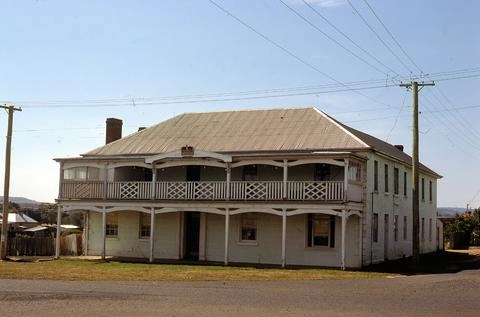
On June 13th, the Crown Inn, located at the corner of Alexander and James Streets, was severely damaged by a fire. The residents narrowly escaped with their lives, but the building was largely destroyed. Remarkably, by November 26th, the hotel had been completely rebuilt and newly furnished, ready to serve patrons once again.
The building has been newly renovated and is now the Bothwell Hotel of the Highlands.
Photo: Greg Dickens taken some time in the 1970s. Source: UTAS.
1895
“BOTHWELL. Bothwell is very dull just now, in keeping with the great depression prevailing all over the colony, and there are at the present time more unoccupied houses in the township than has been known for many years past. Amongst them is that fine building lately erected and used as a branch of the Commercial Bank, and which was closed a week ago, is convincing proof of bad times. The late manager, Mr Charles Drake, without doubt, was a good officer, and always cautious and obliging to all who came in contact with him, and did his best to make the bank pay, but hard times have evidently been too much for him, and the directors, had, therefore, to close the bank. Mr and Mrs Drake were both highly respected by the whole of the inhabitants of the district, and the united hopes of the latter are that the bank authorities may see their way to give Mr Drake another opportunity equal to the one he now loses through no fault of his own.”
TROVE: The Mercury (Hobart, TAS : 1860-1954), “Bothwell,” 10 Apr 1895, p3 (https://trove.nla.gov.au/newspaper/article/9338162)
1897
“This year we have not had many visitors, and those who have honoured us with their presence must, while strolling round, be struck with the neglected appearance of some of the buildings and fences. One building in particular calls for comment, viz, the Wesleyan Chapel, which presents a very unsightly appearance. There is scarcely a whole pane of glass in the windows, the boundary fences are broken more or less, and also the grave fences. This is almost in the centre of the township. One would think that the trustees of the Chapel would try to make the building an ornament to the place instead of what it is now.”
The Mercury (Hobart, TAS : 1860-1954), “Bothwell,” 22 Apr 1897, p3 (https://trove.nla.gov.au/newspaper/article/9395682).
1900
“BOTHWELL. The township of Bothwell, situated 1100 feet above sea-level, is the centre of an important pastoral area, and possesses good hotels, at moderate tariffs, with ample facilities for horse or vehicle excursions. There are many charming walks and drives amidst its environs, notably the Clyde Falls, two miles distant, whilst to sportsmen it offers many attractions. The Clyde River, which flows through the township, is well stocked with English trout, rabbits can be shot within walking distance, and good kangaroo, wallaby, and wild pigeon shooting is obtainable within a few miles. It possesses a good public library; and to those in search of rest and health, Bothwell can be recommended. It is pleasantly situated on the River Clyde, in the county of Monmouth, and electorate of Cumberland, and is distant forty-six miles north-west from Hobart. There is a post, telegraph, and money-order office, and a savings bank, and a branch of the Commerical Bank of Tasmania. Several churches, schools, a working man’s club, assembly room, flour mills, brewery, cordial manufactory, fellmongery, and a tannery go to make up an attractive-looking town. There is daily communication with Hobart by way of Brighton, where the coaches meet the trains. The rural municipality of Bothwell was proclaimed on 22 December, 1862. It has an area of 297,065 acres, and the annual value of rateable property is about £18,000, while the length of roads and streets is 134 miles. Sheep-breeding is the principal industry, but horse and cattle raising and farming are also followed. In the summertime, coach communication with the Great Lake, the favourite resort of angles, is maintained from Bothwell, and is largely availed of, this being the most direct route from Hobart.”
Libraries Tasmania: The Cyclopedia of Tasmania, Vol 1, 1900, Bothwell, p439/1900 (https://libraries.tas.gov.au/Digital/25841).