
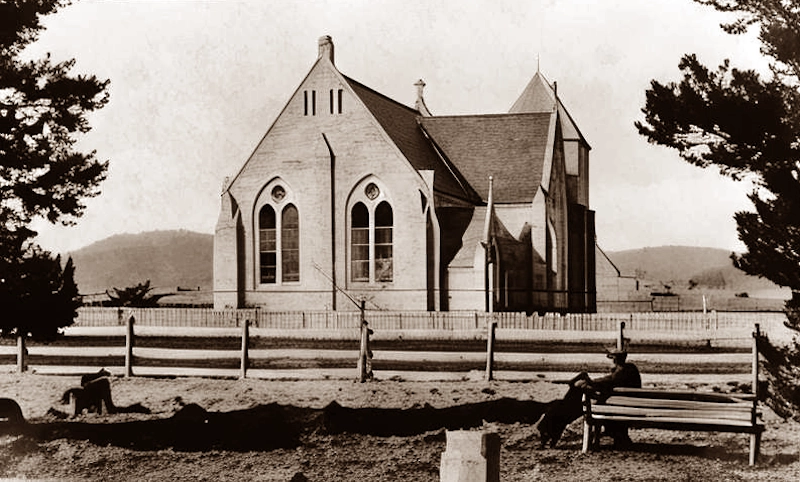
The 1891 consecration of St Michael and All Angels’ church
This record of the church’s consecration is particularly poignant since the church was deconsecrated on 7 December 2025
Photo reportedly taken 1920. Attribution not available. Note the wooden steeple.
The article below is from the Hobart Mercury of Thursday 22 October 1891. On reading it, you feel that you could have almost been there!
Source: Trove. The Mercury (Hobart, Tas. Thu 22 Oct 1891)
https://trove.nla.gov.au/newspaper/article/12729054
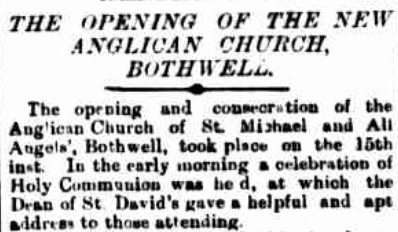
The snippet shows what the original article looked like.
The full transcript is below.
THE OPENING OF THE NEW ANGLICAN CHURCH, BOTHWELL
The opening and consecration of the Anglican Church of St. Michael and All Angels’, Bothwell, took place on the 15th inst. In the early morning a celebration of Holy Communion was held, at which the Dean of St David’s gave a helpful and apt address to those attending.
The foundation stone of this handsome edifice was laid about four years ago by Mrs. William Nicholas, late of Nant, in the presence of Bishop Sandford and a large concourse of people. During his speech upon that occasion the late Bishop of Tasmania remarked, “That with such a talented architect as Mr. Alex. North we might reliably expect a beautiful building, and with such an experienced builder as Mr. Thomas Lewis we could rest assured of a solid and enduring structure,” observations which have been most fully realised.
Upon arrival of the coach at 1 pm a luncheon was given to the clerical visitors by the leading churchmen of the parish. This, it is needless to add, was much appreciated.
By 10 minutes to 3 some 500 people had assembled in the church, or about it, to take part in the ceremony. Punctually at that hour a long procession of surpliced choristers and clergy, including the Dean, the Bishop, and his chaplain, bearing the pastoral staff, was formed, and preceded by a banner-bearer marched round the church singing to the echo the stirring hymn, “Urbs Beata.” Arriving at the chief entrance the usual demand for admission was made by the Bishop knocking upon the closed door with his staff ; and upon admittance he had presented to him the formal demand for consecration. This was read by one of the churchwardens. Then followed the reforming of the procession, and finally all its members were seated in the choir stalls with the exception of the Bishop and his chaplain, who were within the sanctuary. The “Form of Consecration”, with slight amendments, was that used recently at the opening of S. Paul’s Cathedral, Melbourne. This was evidently the work of a learned and able liturgist, and upon this occasion was seen and heard to its greatest advantage. The choir, under the able guidance of the Rev. C. H. Dicker, of Hamilton, rendered its part most beautifully, whilst the Bishop, with his dignified and manly presence, performed the various acts of consecration nobly and well. His sermon was a model of simplicity, greatly resembling, if we may coin an expression exactly suitable, one of Charles Kingsley’s studies in pure Anglo-Saxon. The offertory was about £30. This was good when it is remembered that nearly all present had given largely on several occasions prior to this. A recessional hymn brought to a fitting close a large and important, not to add a very beautiful, work, but also a striking and stately sacred ceremonial.
The church is built throughout with a warm-tinted sandstone of first-class quality. This stone was the gift of Mr. J. D. Wood. The plan of the church is cruciform, with the transepts being each double arched, so that from the interior they appear as aisles. One of the transepts has been separated temporarily as a choir vestry by crimson coloured curtains, most artistically arranged by a certain lady parishioner. A dwarf stone wall divides the chancel from the nave, which at one end runs out so as to form the pulpit, the front of which is decorated by a large and costly mosaic figure of our Lord. This is the gift of the architect. The central feature in the church is doubtless the altar table, which was resplendent with gold and crimson hangings. The altar, and indeed almost all the chancel furniture, are gifts from the communicants. The prayer disk and chair, splendid pieces of work, are the gift of Mrs. William Nicholas. About half of the seats were presented by individual parishioners. The font is a unique and attractive piece of stone work. There are no less than five memorial windows which cost in the aggregate upwards of £300. The surplices and cassocks are the work of a small band of ladies under the skilled leadership of Mrs. Perkins, who also made all the other crimson hangings. The church people feel thankful for such work, so good and tasteful. The seats are provided with kneeling boards. These are from drawings by the well-known architect, Mr. Butterfield. The design of the church reflects the highest credit upon Mr. Alex. North, of Launceston, the architect. And the solid, honest, splendid stonework is the highest possible commendation that Mr Thomas Lewis, the builder, can wish for his future contracts.
The evening was brought to a close by a tea meeting, patronised by some hundreds. A concert and children’s cantata terminated the day’s festivities, all of which reflect credit of the highest kind upon those who planned and carried them into effect.
Some background
The stone steeple was built much later than the main church with construction finishing in 1921, though the intended spire was never added. The church itself was started in 1887, designed by Alexander North, but funding issues meant a temporary wooden bell structure (see image at top of page) was used until the stone tower was completed decades later, with Governor Sir William Allardyce opening it in August 1921.
The wooden extension on the north side of the church is a “temporary” structure built to complete the unfinished north transept, part of Architect John North’s original grand design.
Refer Churches of Tasmania No. 447 – St Michael and All Angels’ at Bothwell – ‘An Unfinished Gift’

The Hymn
The hymn Urbs Beata is the Hymn for Evening Prayer for the Dedication of a Church. More information on it can be found here. You can hear it via the YouTube clip below.