
Bothwell in 1867, photographer unknown
Bothwell: Family History
Our local historian, Mary Ramsay, is a Bothwell treasure who is immensely knowledgeable about Bothwell, the town, its architecture, and its history including the history of the families who settled and have lived in Bothwell and surrounds. Mary will answer queries about local history and local families if they are not too time consuming. She can direct longer queries to other relevant people and sites. If you would like to explore a Bothwell family history, in the first instance, email Mary at ratho1@bigpond.com
Mary has contributed the following brief history of Bothwell:
Bothwell: A Brief History
Bothwell: A brief History
by local historian, Mary Ramsay
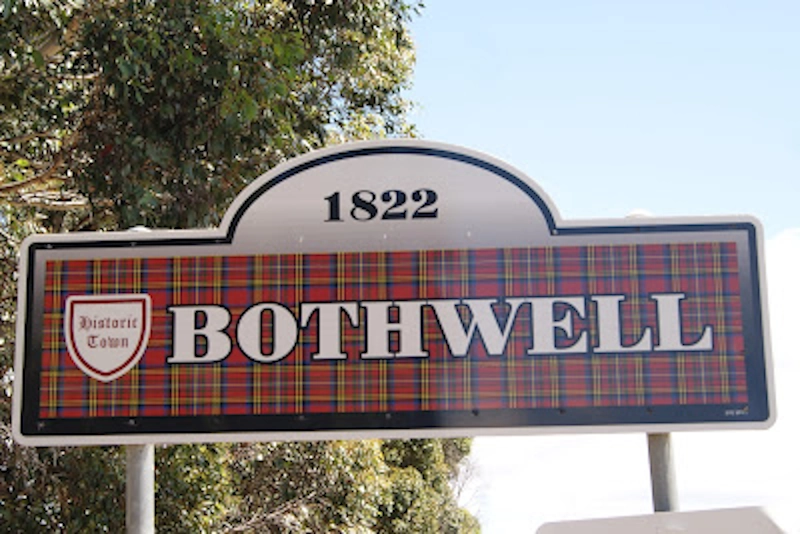
Bothwell is a small farming village on the Clyde River in central Tasmania. It calls itself the gateway to the highlands. It is the last commercial stop before the hunting and fishing central plateau area. Major farms surround it. The area was settled in the 1820s. Many major buildings were constructed using local sandstone and hand made bricks.
It is therefore one of Australia’s earliest historic towns but its fame does not rest on this alone. Bothwell has been home to far more people of fame and ability than is usual for such a small place.
The aboriginal people who lived in this area were called the Mumirimina people [Note 1]. They have not been thoroughly studied and there is still debate on the numbers and formation of the group which was known as the Big River tribe. The Mumirimina who were nomadic, occupied the central highlands. Members traded with neighbouring groups such as with the Oyster Bay tribe [Note 2] and there were defined pathways through the Bothwell district. There was a pathway up from the Jordan River at Miles Opening near Woodspring on the Limekilns Road. It was often where these pathways crossed newly settled farms that clashes occurred between the Mumirimina and settlers. It is known that the local indigenous tribe kept the plains around Bothwell fired so that it was open country. The ancestors of the Mumirimina inhabited Tasmania for 35,000 years. The last members of the band were found by George Augustus Robinson near Lake Fergus at the end of 1831. The band included members of the Oyster Bay group as well. It numbered 26 people. They walked down into Bothwell with about 100 hunting dogs and camped outside the Castle Hotel in January 1832. Here they danced their last corroboree in their native land before walking down to Hobart. They were then shipped across to the islands in the Furneaux Group. Evidence of their occupation is seen in the caves around Bothwell and the flints and other tools that turn up in the river valley. A recently published book by Graeme Calder1 gives a more detailed account of the Mumirimina.
After the British settlement at Risdon Cove was established in 1803 cattle found their way up the rivers to this area, as did the hunters who were sent out to find food when the settlement was starving. After them came the stock-keepers with their herds who grazed under government licence on the open plains. They lived in crude huts such as the one at Hunterston where the bushranger Michael Howe was captured in 1818.
After almost 20 years of settlement it was realized that the colony of Van Diemen’s Land was a suitable place for the rearing of sheep for wool. This would bring in some welcome income to the colony. Governor Sorell toured the area and instructed that the land be surveyed and made available for settlement. Then the boats started arriving with men of means, their servants and farm implements.
The Grace was first ship to bring people who settled in this area. These were the Nicholas family who came to Nant and later to Meadsfield, and the Rowcroft brothers who were granted Norwood and Grassy Hut. The Nicholas family brought millstones with them and were able to value add on to their farm income by grinding other farmers’ wheat. They built a mill on the banks of the Clyde part of which stands to this day [Note 3]. The settlers who arrived by the Castle Forbes in 1822 were mainly Scots and many were from Fife. The group had been organised by Captain Patrick Wood, a retired East Indian Army man who came out accompanied by a farm overseer, housekeeper, stonemasons, farm hands and other people useful in establishing a settlement.
Andrew Bell, a Scottish stonemason who came out with Captain Wood built some of the most architecturally significant houses in Tasmania. In 1824 Captain William Clark came out with his family and settled at Cluny. By this time a town had been laid out by the surveyor James Scott and substantial houses were being built on adjacent farms and along the Clyde River and its tributaries. A second water-mill was built on the Clyde at Thorpe by Thomas Axford in 1823. This still stands and is currently being restored. Later just as the rules about granting land were being altered the McRae family followed out their Scottish kin the McRas [Note: not a typo] who were living at Abyssinia. The McRaes found land at Selma and Hartfield to the west of Bothwell near where the Ouse and Shannon Rivers meet. The town acquired low taverns like the Plough & Harrow as well as respectable inns, a barracks, shops, and a blacksmiths.
St Lukes church was opened in 1830. Before this Archibald McDowall had been appointed the Commissariat Clerk and catechist for the district. The church was unusual in that it was built for the use of Protestant congregations and for sixty years both Anglicans and Presbyterians held services there. Archibald McDowall had come out on the Portland with his family in 1824. The McDowalls were from Ayrshire in western Scotland. Archibald was a great supporter of hard working convicts and helped many of the married men to bring out their families, men like Edward Bowden (or Bunnet) and Joseph Thorogood.
The Methodists built a sandstone church in Dennistoun Road which flourished while George Ife was a shop-keeper in the town and Robert Blake provided financial support. After Ife moved to Hobart it declined and eventually when it was obvious that the railway line would never be built to Bothwell the church was sold and demolished and the materials used in other buildings such as can be seen in High St where The Keep and Barwick Cottage both include Methodist church sandstone.
Bibliograpy
- Calder, Graeme. (2010). Levee, line and martial law : a history of the dispossession of the Mairremmener people of Van Diemens Land 1803-1832. Launceston, TAS. Fullers Bookshop
Some additional notes
Added by site creator, Dallas Lewis
1. Mumirimina spelling: Unless in a book title or in a quote from elsewhere, this website generally uses the palawa kani (meaning “Tasmanian Aborigines speak”) standardized spelling system developed by the Tasmanian Aboriginal Centre (TAC) to provide a consistent written form for the reconstructed language of the Tasmanian Aboriginal people. This is an alphabet devised specifically to show the original sounds of Tasmanian Aboriginal language, rather than the recordings made by scribes of many nationalities who tried to capture unfamiliar Aboriginal sounds in their own European – mostly English ‐ spellings. For instance, Mumirimina is the palawa kani spelling of the word which G A Robinson attempted to transcribe as “Moomairremener’. Note that the palawa kani spelling and Robinson’s attempt at spelling it phonetically in English have an extra syllable compared to the commonly used Mairremmener spelling. palawa kani names for people and tribes begin with a capital letter (Mumirimina; Tukalunginta), but the names of places and geographical features have no initial capital letter (eg yingina/Great Lake)
2. The Oyster Bay Tribe, also known as the Paredarerme or Paritarami, was the largest Aboriginal group in Tasmania before European colonisation, inhabiting a vast area on the east coast, including the Derwent estuary, Tasman Peninsula, and inland to the Midlands, known for their rich resources, bark canoes, and complex society. Their culture, including clans like the Mumirimina, faced destruction from colonization, but their enduring connection to country is recognized today, with sites like the Sorell Municipality acknowledging the Mumirimina as Traditional Owners.
Source for Notes 1 and 2: Tasmanian Aboriginal Centre. (2012). Mumirimina people of the Lower Jordan River Valley. Hobart. Tasmanian Aboriginal Centre. (The sixteen page PDF is available for download here)
3. Edward Nicholas was the first European settler in the Bothwell region. He had chartered the ship Grace, and along with his brother William and other family arrived in Van Dieman’s Land in August 1821 with workmen, machinery and seeds to the value of 1800 pounds, for which he was granted 1800 acres of land in an area then known as Bark Hut Plains on the Fat Doe (now Clyde) River.
Edward and William Nicholas were brothers. There is substantial historical detail about Edward, but what happened to William is a mystery apart from his headstone in the Bothwell cemetery.
Edward named his property ‘Nant’, a word meaning ‘a valley’, after his family home he left behind in Abergavenny, Monmouthshire, in South Wales.
By 1825 the first flour mill on Nant was built to serve the property. The present mill was built in 1857 (according to a date stone set in one of the walls) to replace the previous mill, and operated until 1890.
Today, the historic mill and estate have been revitalised as Clyde Mill Distillery, now owned by the local Ramsay family, focusing on whisky, gin, and a farm-to-glass dining experience, continuing the site’s legacy under a new name but with the same historic spirit.
Source: https://tasnationaltrust.blogspot.com/2016/10/national-trust-tasmanian-heritage_58.html Entry 98.