
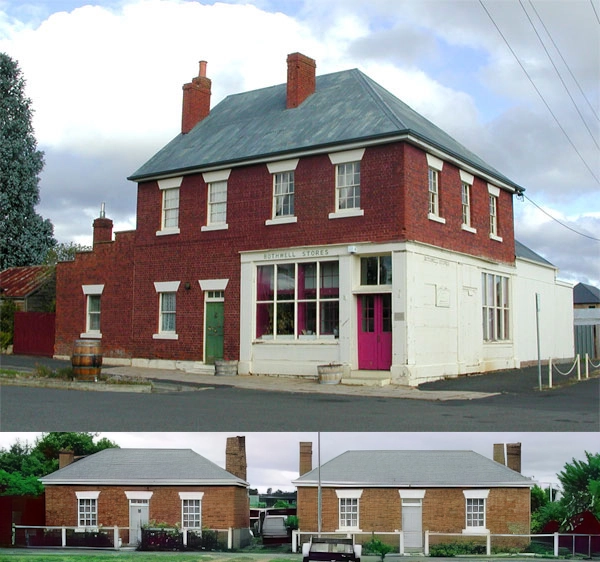
This is an article about the development of Archibald McDowall’s property, which now, from west to east, comprises Sealy’s, a newer house and the Twin Cottages. It has been transcribed from a copy of a typewritten document prepared in 1986 by Peter Fielding for the Bothwell Historical Society.
Twin Cottages image: Dr Warren Nichols (1979)
Sealy’s image: Dorothy Evans (2009)
The Development of
Archibald McDowall’s Property
Alexander Street, Bothwell
The history of the Bothwell district, REPORT No 1,
compiled by Peter Fielding for the Bothwell Historical Society.
Published October 1986
Price $1
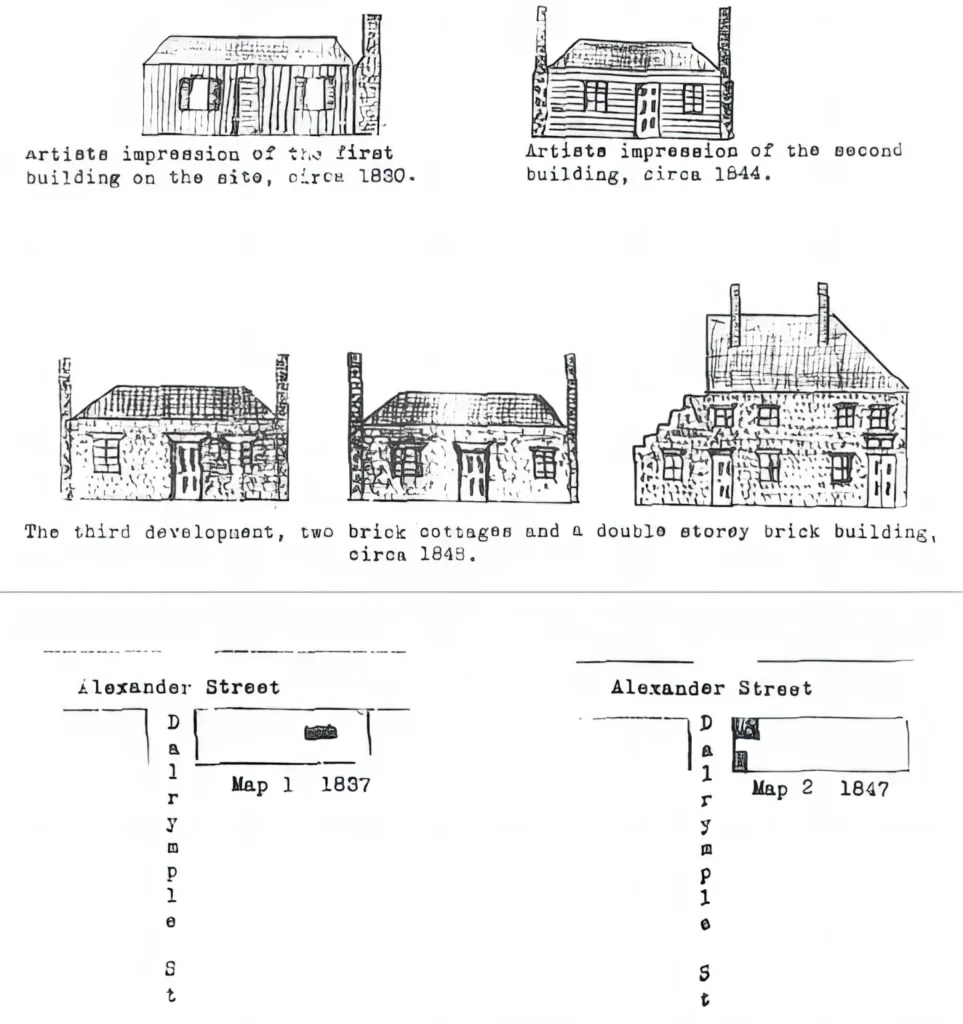
A block of land (2 roods, 14 perches) situated on the corner of Alexander and Dalrymple Streets was granted to Archibald McDowall1 during the early days of settlement. An undated map2 of the town estimated to have been drawn about 1831 shows only one building at the eastern end of the block where a brick cottage now stands. It is assumed that this building was constructed about 1830 from wood and brick. Macland’s town map of 1837 also shows a building at the same location. When McDowall sold the property in 1843 for £1303, what is thought to be this building was described as a tenement indicating that McDowall leased the building to various tenants.
Most of the following land owners continued with McDowall’s tradition of leasing buildings. One of McDowall’s last tenants was George Smith who occupied the wood and brick building in 18424. Legend has it that the first store in Bothwell operated from this block of ground suggesting that at some stage the building must have been used as a shop due to the fact that a store would have operated in the early days of Bothwell’s development. James Backhouse6 found that Bothwell had a church of stone, a brick public house, about thirty wooden houses and a wooden jail when he visited the town in 1832. Undoubtably this building was a typical settler’s dwelling that Backhouse described as having walls constructed from upright logs, a shingle roof with a fireplace and chimney at one end. Two unglassed windows with shutters let light filter into the two rooms. In one room all cooking was done over an open fireplace, logs of wood or wooden benches served as seats. In the bedroom rough benches were used as beds. Wall crevices between the logs were plugged with a material such as wool. Some householders left the gaps uncovered.
McDowall’s building did not appear on Calder’s town map of 18475. Possibly it was destroyed by fire about 1844. Two other buildings on nearby properties also did not appear on the map suggesting that three buildings were burnt in the one fire. The fire would have caused redevelopment to occur on this and adjoining blocks.
Thomas snr, Thomas jun, and William Harris purchased McDowall’s property in 1843. In 1844 they borrowed £2007. The money was possibly used to erect a new building on the corner of Alexander and Dalrymple Streets which included an out building (refer map 2). It is not known if the main building was constructed from masonary or timber but was probably a pit sawn, timber plank building with a shingle roof, brick chimneys, 12 pane glass windows, and had four rooms. It possibly had a row of bricks between the wooden planks and the interior walls. Several other houses in Bothwell of this vintage have this feature. The Harris family were local shopkeepers but it is not known if the building was used as a shop.
The Census of 18488 states that Thomas Harris had an unfinished brick building that was inhabited by six people, two were convicts, and Harris and Co. had an unfinished, uninhabited, brick building in Bothwell. Exact location was not given on the Census forms. If the buildings were on this property, it is assumed that they refer to the two cottages. Some people that rented the two brick cottages were: Ann Sherwin 1858-1867, John Waldon 1859, John Easton 1860-1866, Zachariah Smith 1867-1868, William Taylor 1868-1870, Andrew O’Harns 1869, John Smith 1870-1880, Mrs Putwain 1871-1873, John Hannigan 1874, George William Ife 1875-1879, Charles Blake 1880, Mrs Harn 1880, F.L. Dickson 1881, James Moyes 1881-1883, Arthur Taylor 1881, Frederick Cooper 1883, A. Blake 1884, Mrs. Pitt 1884. After 1884 it was impossible to trace the people that rented the two cottages as the owner had other property in Alexander Street. One of the brick cottages appears to have been used as a baker’s shop as the present owner, Mr. Albert Turner, recently found a baker’s oven when he was renovating. It is likely that James Moyes was the baker as he used a cottage as a shop in 1882 and 1883.
A sum of £300 was borrowed 10 May 18499. It is suspected that this money was to finance the construction of a two storey building on the corner of Alexander and Dalrymple streets. The money appears to have run out when the building was only half completed. Even today it retains its half finished appearance. This building must have been used as a boarding house soon after construction. In 1858, Irish exile John Martin, while boarding with Mrs Harris described the building as “… the staring big, red brick house at the corner diagonally opposite the principal inn”10. Storekeeper, George William Ife, appeared to be renting the building in 1856 as he wrote his name and this date on a packing case wall upstairs. Ife’s name and date was found when the Wilsons, the present owners of the building, were renovating. It appeared to be a common practice for people to put their name and date on walls before painting or covering during the last century. It is not known if the building was used as a shop before 1856. In the valuation rolls, Ife is on record as renting the building as a store from 1858 (when the rolls first started) to 1879. An indication of prices that Ife charged in 1858 is given in a Government contract11 that he won. The prices were: bread 2d per pound, candles 9d per lb, cotton wick 2/6 per lb, flour 3d per lb, fresh meat 6d per lb, oil 8/- per gallon, soap 7d per lb, vegetables 2d per lb, wood 14/- per ton. After Ife vacated the store, it was used as a house until 1882, when Henry Hurley used it as a shop until 1889. G.B. Sealy rented the store 1890-1891. He was the first Sealy to serve the people of Bothwell from this store, a tradition that lasted until 1984, when Allen, Dorothy and Gladys Sealy sold the store. In 1890, plans were drawn for Mr. Sealy to convert downstairs into a modern store and to extend the building12. It is assumed that the store alterations commenced soon after the plans were made, but, for some reason the extensions that would have completed the building were never made. William H. Sealy took over the store in 1892. He was still listed as shopkeeper in 1912 when A.B. Sealy became the first Sealy to actually own the store.
Property owners were: Archibald McDowall 18?? to 1843, Thomas snr, Thomas jnr, William, and Sarah Harris 1843 to 1858, Henry Speak 1859, James Harcourt 1860-1879, Henry Hurley 1880-1889, Mrs. Hurley 1890-1895, Mrs. Napper 1896-1911 and various members of the Sealy family 1912-1984. Since 1984, Marie & Noel Wilson have been carrying on the Sealy tradition of serving the people of Bothwell from this historic corner store. The final development took place in the early part of this century when a weatherboard house was erected between the store and the brick cottages. The weatherboard house is the only property that the Sealy family still own on the block. Mr. Albert Turner is the present owner of the brick cottages.
[Update: The current owners are Mr Brady Meyers and Ms Gemma Fahy]
This is not considered to be a complete history of the block, much more information still has to be unearthed. My thanks to V. Martin, M. Wilson, F. Barnard, M. Ramsay and A. Turner for valuable information.
REFERENCES
1. P. Macland, map of Bothwell, July, 1837, map B/43 Lands Dept
2. Circa 1831 map of Bothwell, map B/39 Lands Dept. cn
3. Conveyance 2/6819 Lands Dept
4. 1842 Census Cen I/I stlx/ ao / ep / 30
5. J Calder map of Bothwell, April, 1847, B/40, Lands Dept
6. James Backhouse, A narrative of a visit to the Australian Colonies. P.28-29
7. Conveyance 3/4822, Lands Dept
8. 1848 Census Cen/I/69
9. Conveyance 4/6849, Lands Dept
10. K.R. Von Stieglitz (1958) The History of Bothwell
11. 1858 Hobart Town Gazette
12. 1890 plans for the store, property of M. & N. Wilson, Bothwell1
Valuation rolls 1858-1912