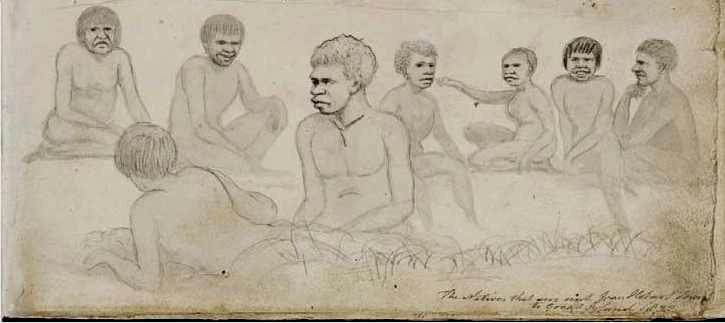
The Mumirimina people
While the mission of the Bothwell Historical Society is principally the preservation of our European history since the early 1800s, no history of Bothwell would be complete without acknowledging that Indigenous Australians had successfully inhabited our region for countless thousands of years prior to, and for them, the unwelcome and disastrous arrival of the Europeans.
The following except is from our own publication: Bothwell Revisited. A History: Foundation, Federation and the Millenium (2001). It can be purchased (price $35) from our Museum at 4 Marketplace, Bothwell.
During twenty thousand years of occupation by indigenous Aboriginal tribes on this island, a band of the Big River Tribe was located around Bothwell. The Lugger-mairrerner-pairrer people were based south-east of the Great Lake. Domed huts and caves provided shelter; garments of fur, warmth and firesticks, and spears were of prime importance. To obtain food and other necessities and make contact with other friendly bands, the tribe made periodic excursions along river valleys and via a network of well-defined routes, often through rough terrain. They accessed seasonal foods such as wallaby, wombat, birds and their eggs, seal, shellfish, grasstree, bracken, seaweed, pigface, and orchids.
The Big River Tribe is estimated to have numbered 500 when Europeans settled in Bothwell in 1820. Other bands of the tribe were located further west and south and although the Lugger-mairrerner-pairrer occupied part of the Central Plateau, they ranged widely over the Bothwell area and beyond. Stone implements found at Lake Augusta on moors at 1,200 m altitude are on display in the Tasmanian Museum and Art Gallery in Hobart. Friendly relations with the Oyster Bay Tribe led to exchanges of visits, hunting, and foraging at Pittwater, Oyster Bay and Macquarie River. A pass through the Western Tiers by Quamby Bluff enabled access to the ochre mines at Mount Housetop and Mount Vandyke in the territory of the Northern Tribe, and some trips to Cape Grim on the West Coast, took the band 240 km from their base at the Great Lake. Relations with the Midlands Tribe were not good.
The area where Bothwell lies was abundant with game and its settlement became a major threat to the Aborigines. Interactions with the settlers were tense at the outset and deteriorated rapidly as thousands of hectares of land grants were taken up, stocked, cleared, and makeshift dwellings were built. Shepherds in isolated huts on bush runs were particularly vulnerable to surprise attacks by small groups of Aborigines armed with spears and firesticks, although the shepherds did have firearms at their disposal. Between 1822 and 1831, Big River people killed at least sixty Europeans, raided huts for weapons, blankets and stores, speared stock, burnt haystacks, huts, fences and homes, and annexed or razed grazing areas. About 240 Aborigines were killed and less than sixty remained by 1831, severely reducing their chances of survival, but intensifying their efforts to retain control of their traditional lifestyle and territory against mounting odds. Settlers built secure and substantial houses, barns and walled stock enclosures, and were well armed. Bushrangers, settlers and stockmen exacerbated the antagonism by ill treating the race, sometimes abducting Aboriginal women.
In 1829 the Bothwell magistrate estimated that he needed three times the thirty military he had in the district to properly protect the settlers. After an attack on ‘Sherwood’, its owner, John Sherwin, wrote to Governor Arthur prompting a meeting which thirty-three settlers attended to discuss their position. Increasingly smaller groups of Aborigines continued desperate raids with more organised opposition. The Secretary of State in London expressed concern that the Aborigines may be exterminated; this did not deter colonial administrators. The Black Line exercise aimed to capture the remaining Aborigines and confine them to an area on the Tasman Peninsula where they could learn European ways. Two thousand men assembled to drive the Aborigines south; it was a dismal failute. So the task of ‘Conciliation’ with the Aborigines was given to George Robinson, who met with a group of twenty-six war-weary Aborigines, who had about 100 dogs with them, near Lake Echo. The group was angered by the injustice meted out to their people, devastated by their decimation and keen for some compensation for their dispossession. They agreed to accompany Robinson to Hobart and en route performed a corroboree outside the Castle Hotel in Bothwell in January 1832. The Big River Tribe had left their home territory forever, less than ten years after European settlement.

The following is from Mumirimina people of the Lower Jordan River Valley, a publication by the Tasmanian Aboriginal Centre. The full 16 page publication can be downloaded here.
The last of the Big River and Oyster Bay people were captured by government agent George Augustus Robinson in December 1831 somewhere near Lake Echo on the central plateau. They numbered sixteen men, nine women and one child, led by Big River chief Montpeilliater and Oyster Bay chief Tukalunginta. Tukalunginta told Robinson that the “reason for their outrages upon the white inhabitants [was] that they and their forefathers had been cruelly abused, that their country had been taken away from them, their wives and daughters had been violated and taken away, and that they had experienced a multitude of wrongs from a variety of sources. They were willing to accept the offers of the government…” “who Mr Robinson promised would readily comply with all their wishes and supply all their wants”. They believed the white man owed them compensation for the loss of their land. They travelled with Robinson to Bothwell and hunted that night on Den Hill. Local history has it they danced a corroboree in front of Bothwell’s Castle Hotel on 5 January 1832 before walking on to Hobart to be removed to Flinders Island – this was their last corroboree on their own lands.1
The Hobart Town Courier breathlessly reported that the residents of Hobart turned out to watch “with…delight’’ as Robinson paraded his captives into Hobart, and enthused that “The removal of these blacks will be of essential benefit both to themselves and the colony. The large tracts of pasture that have been long deserted owing to their murderous attacks on the shepherds and stockhuts will now be available, and a very sensible relief will be afforded to the flocks of sheep that had been withdrawn from them and pent up on inadequate ranges of pasture …which..has tended materially to impoverish the flocks and keep up the price of butcher’s meat..”2
In order to lower the price of mutton, Aboriginal people were exiled to Flinders Island and the entire structure and fabric of their life destroyed. In less than 30 years, the 800 Oyster Bay people had been decimated to a score of survivors who would never see the Jordan River valley or any other part of their land again. The Hobart Town Courier also noted “the very small number” of Aborigines remaining free. By 1842, all Aborigines outside the “Settled Districts” had been incarcerated on Flinders Island.3
1. Robinson to Aborigines Committee, 25 January 1832, TSA CSO 1/332, in Plomley 2008: 601‐5; Plomley 1987; 43 n.33; Hobart Town Courier, 14 January 1832; Ryan 1996:121‐2; Felton 1999: 3:19 map; Bothwell Revisited, Bothwell Historical Society cited in Ratho Golf Links website 7.1.2010
2. Hobart Town Courier, 14 January 1832, 7 January 1832; Robinson’s official report of 25 January 1832, in Plomley 2008: p602‐6].
3. Ryan 2008:23; Ryan 1996:112, 197‐9; Hobart Town Courier, 14 January 1832]
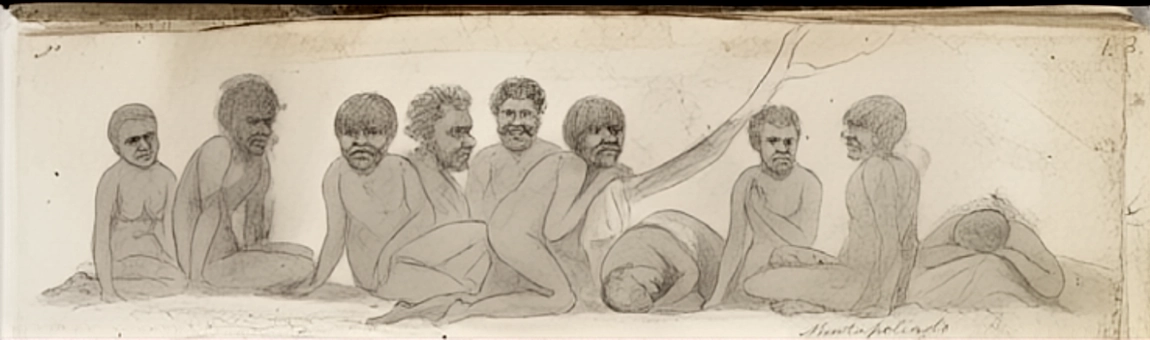
Here’s another of John Glover’s drawings of the Mumirimina just prior to their deportation to Flinders Island.